Pages

Data mining through education

Sunday, May 27, 2012

Hi all,

It has been a while since my last post. I had to be offline for some months to work harder in bigger project in the educational field.  I love teaching and specially share content including machine learning and data mining topics. But I decided to go further and I co-founded with my partner Gileno Filho a educational platform to teach Python around Brazil called http://www.pycursos.com


It is a e-learning platform with one main goal: spread the programming language Python around Brazil by teaching the platform and its applications such as the course about regular expressions, scientific computing with Python and now web development with  Django Python. A lot of work and a lot of learning as well. The result in 4 months was amazing! More than 100 students already studied with us, with projection until July with more than 500! I know it isn't an incredible number but without any efforts on marketing only on the word-of-mouth we accomplished these results.

But more news will come specially in machine learning! It's not news that I've been working for about three years in educational field, where I managed as scientist chief in the brazilian social network atepassar.com

With all this background I will start to post more about data mining applied on educational such as  how can you rank the courses or how can machine learning can assess the student mastery.

So join me in this journey, and see how all this data can be used through the tailoring of student's experience.

Cheers,

Marcel Caraciolo


Some data and machine learning talks videos from PyCon Us 2012

Monday, March 12, 2012


Unfortunately this year I couldn't participate of the PyCon, the world meeting of Python developers. I had a poster accepted this year, but I had some problems that didn't allow me to go. Apart from that, the best part is that I could watch talks, tutorials and keynotes from the congress.

Thanks to the PyVideo team, they uploaded all the videos from the PyCon quickly! The best ones that I enjoyed (of course related to data mining, natural language processing and machine learning) I will share with you:


17. IPython: Python at your fingertips


There are some of talks and tutorials that I enjoyed a lot. I recommend you to take a look at all the videos available from PyCon at this link.

I really hope next  year I can go to this meeting :)

Cheers,

Marcel

Guide to Recommender Systems Book Online

Friday, February 24, 2012


Hi all,

This year one of my goals is to write a book such as a guide to teach recommender systems for programmers. I know there are several textbooks that focus on providing a theorical foundation for recommender systems, and as result, may seem difficult to understand. For programmers that want to learn how to start to use or understand the components of a recommender system, this book is what they are looking for.  

This guide follows a learn-by-doing approach. Therefore, I will use theory and apply it through the exercises and experiment with Python code.  I hope when you complete the book you will be able to understand how to build a recommender system and give you the first steps to apply them at your own systems. The textbook is laid out as a series of small steps that will guide you for undestanding the recommender system techniques. 

This book is available for download for free under a Creative Commons license. This project is also leaded by my colleague Ricardo Caspirro, who will review and translate it to portuguese language.

Below I provide the table of contents of the book.


Guide to Recommender Systems


The link for the online guide is available here.


http://muricoca.github.com/recommendation-lectures/index.html


Table of Contents


Chapter 01: Introduction to Recommender Systems

Finding out what recommender system is and what problems it solves. And a fast review of what you will be able to do when you finish this book.

Chapter 02: Collaborative Filtering

This chapter focus on how you can use the state-of-the-art techniques of collaborative filtering that makes automatic predictions (filtering) about the interests of a user by collecting preferences or taste information from similar users (user-based) or similar items( item-based).


Chapter 03: Content Based Filtering
Recommender systems that  suggest an item to a user based upon a description of the item and a profile of the user's interests. Although thedetails of various systems differ, content-based recommendation systems share in common a means for describing the items that may be recommended, a means for creating a profile of the user that describes the types of items the user likes, and a means of comparing items to the user profile to determine what to recommend. 


Chapter 04: Hybrid Based Filtering
This chapter will focus how to pick the best features of collaborative and of content and mix them to build hybrid recommender systems. It will present the current work on this field and an example of  how it works and how you can decide the best strategy to select.

Chapter 05:  Model - Based Recommenders
Techniques that will include memory-based techniques or data mining techniques such as association analysis, symbolic data analysis and classification/clustering techniques will be covered in this chapter.

Chapter 06:  Evaluation of Recommender Systems
This chapter starts with a short description on how to evaluate the recommender systems and the commonly used metrics for compare the recommender algorithms in the development and deployment stages.

Chapter 07:  Recommender Systems and Distributed-Computing
Recommender Systems suffer with sparse matrices where the user x items preferences are sparsed (lots of missing values - preferences). It results on large datasets with millions of items, users and preferences.  For this task it is considered to use distributed computing techniques such as map-reduce to distribute the recommendations. This chapter will cover those topics.

Chapter 08:  Study Case
It will present a study case of a mobile recommender system for recommend users to another users using several techniques showed above and how we tested and deployed it.

Chapter 09:  Recommender Systems the Next Generation
This chapter brings the next generation of recommender systems, describing what the research is going after in several fields such as ubiquity, semmantics, etc.

Chapter 10:  Meeting Python-RecSys Framework
It will present the Python-RecSys framework for building recommender systems with Python in a easy way. It will describe how to build or test already implemented techniques or develop new ones and deploy them with frameworks Web and REST.


This book is under development, please let me know if there are any suggestions or corrections to make over one of those chapters. If you see that there is a topic that needs an extra chapter or a topic that I am missing, please also let me know and comment.


I hope you enjoy this work, specially the developers!


Regards,

Marcel Caraciolo

The Anatomy of Product Recommendations - Infographic - Tips and Best Practices

Thursday, January 12, 2012

Hi all,

I'd like to share a post that I found recently from a product's blog called LiftSuggest. It is focused on recommender engines for e-commerces and give several tips about how to design your product recommender at your website for maximum clicks and to increase your sales.

They posted a infographic about the anatomy of a product recommender engine. The tips they give are quite important when you are designing a recommender system for your e-commerce. 


Product Recommender Engine

Further information please access their blog.


Regards,

Marcel Caraciolo

Deepjewel - Social Media powering Recommendations

Wednesday, January 4, 2012

Hi all,

Happy new year!  My first post this year will be about an idea that I had with my friend Ricardo Caspirro about the next generation of social recommenders in commerce applications and retail stores. What excites me is that this idea came from a conversation that we had in 2009, and since that year we discussed more about what it would be the "Deepjewel".

Deepjewel is a giant knowledge base that encapsulates interesting entities and relationships of the social world in the web.  The social world in this context means all the millions and billions of tweets, Facebook messages, profiles, relationships, blog posting, YouTube videos, and more - a living organism itself, constantly evolving. 


The Deepjewel

But what motivated us to create the Deepjewel?  One of main problems that we face nowadays is the discovery of content and items of our interest.  Many times, for instance, to find a book or a movie that we like, it is required to search at several websites and social networks through the web.  There isn't a tool that allow this connection between items of many domains in a organized and structured way, even for easy access. Those objects are spread over the web, and the recommendations are placed in social networks by comments, results of machine learning techniques or by queries at several web pages or search engines.  The problem becomes worst when we don't know anything about the existence of a certain item, which it could result at never finding out that possible item that would be of our interest. 

The social media is huge and we need tools that performs a deep analysis of all this data, filter out items of my interest, specially from the historical data  (with our permission, of course)  from our presence in the web and bring items and products relevant to us without loosing the discovery process associated with the serendipity.  One of the solutions is a powerful recommender engine fed by this Social Genome.


Hybrid Social Context-Aware Recommender RecDay


This hybrid social context-aware recommender (which we call recday) is a engine composed by several modular components, which we employ a broad range of semantic analysis techniques, including information extraction and integration, natural language processing and machine learning. The main task of this recommender is to analyze information about his posts, bios and relationships/lists collected from the social genome and summarize it (all this data would represent the interests of the user) in profiles, which we could call DNA. Those profiles built by the recday would infer the possible interests of the users and would serve as basis for personalized recommendations of products and services from the retail stores/e-commerce applications.


A perfect example for this proccess, which we call the translation, is when you mentioned several times about Apple products (such as macbook, ipod, iphone, etc) at your tweets. Even you never used the word "Apple", we can use the Social Genome to detect the products and infer that you are interested in Apple products. The following figure illustrate certain kinds of entities and relationships collected in the Social Genome:


The relationships extracted from the social web data

The second step of this engine is to build the user profile. Different from another approaches which it only uses the content or the historical data from reviews or ratings from the user, the Recday would go further and would analyze the temporal context included in the interests of the user. Several reports on consumer behavior show that the user desires are influented by external factors and even the humour or feelings of the person at the certain moment. It is required to collect in a stealth way (with the user permission of course) his social data and build his personality defined by several dimensions. Those dimensions represent the current state of the user which may define what kind of suggestions he would like to receive at that particular moment. For example, if you are happy today because you got a new job and posted at your Facebook about that event or even updated your profile about this new position, it would be a valuable information for your DNA profile in order to recommend products and services to celebrate this occasion (You are happy and excited, don't you think ?).

Another important component in this proccess is the product side. We need extract more information from their products portfolio. Items must be juiced in order to get all its meta-data available. Imagine the movie Batman where we have details about the year, genre, cast, production, direction, sinoypsis, etc. All this data can be used to build the DNA Item and be expressed by a collection of dimensions that represent the item profile. With those profiles (DNA User and DNA Item) we compute the similarity between user and items in order to produce a list of top recommendations and related explanations.


The Social Architecure of the Recommender


The final result can be shown in several mediums: mobile apps, widgets, web, API's, pluggins, etc. It is important the usability and how you will present all this information for a particular user. That's why the user interface must be simple and easy to navigate and have mechanisms to collect the user's feedback for the suggestions given by the engine. This proccess is cyclic, so when you give a feedback (a like or dislike or a comment about the suggestion), this piece of information is handled and leveraged to power your DNA profile.
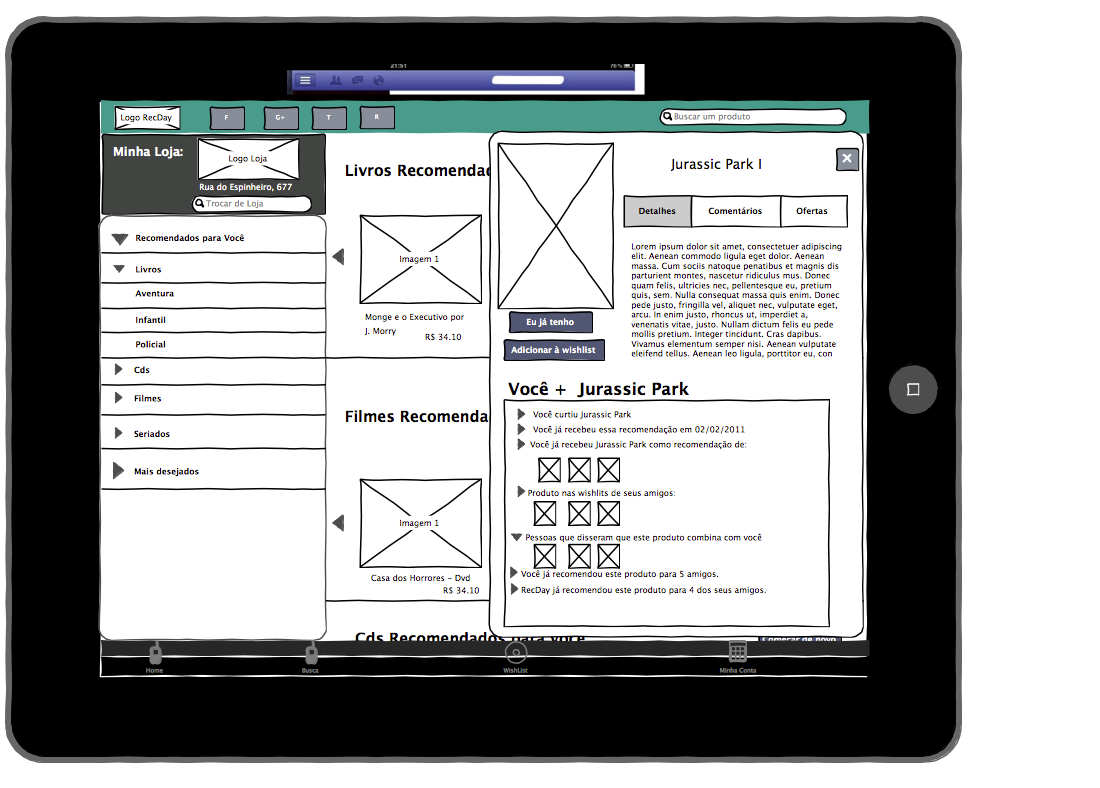
A particular medium of the recommendations: Ipad Demo

In order to build all these interesting technical challenges, we needed to start developing our in-house solution called Crab, which proccesses all this data and employ several analysis and filtering techniques  to deal with the percularities of this heterogeneous sources of data. The first start is the launch of the Deepjewel Labs. Deepjewel is a principle that we can mine the wealth in data, by identifying interesting entities and relationships and converting them into valuable information as input in the recommendation proccess of items and services. 

In summary, all those human and computation techniques can be used to perform a deep semantic analysis of web and social data, where the result for a commerce application or retail store is the ability to offer what the users want before they know that they really want in a personalized way. The RecDay  would be able to daily offer relevant product and services to their customers without they even know it exists. This is a new way to shop in which you don't have to go find products, service and information; the machine will help them find their way to you.

To know more about our Deepjewel labs, visit the website (currently in portuguese):  


I hope you enjoyed,

Marcel Caraciolo