Pages

Showing posts with label article. Show all posts

Non-Personalized Recommender systems with Pandas and Python

Tuesday, October 22, 2013


Hi all,

At the last PythonBrasil I gave a tutorial about Python and Data Analysis focused on recommender systems, the main topic I've been studying for the last years. There is a popular python package among the statisticians and data scientists called Pandas. I watched several talks and keynotes about it, but I didn't have a try on it. The tutorial gave me this chance and after the tutorial me and the audience fell quite excited about the potential and power that this library gives.

This post starts a series of articles that I will write about recommender systems and even the introduction for the new-old refreshed library that I am working on:  Crab,  a python library for building recommender systems. :)

This post starts with the first topic about the theme: Non-personalized Recommender Systems and giving several examples with the python package Pandas.  In future I will also post an alternative version of this post but referencing Crab, about how it works with him.

But first let's introduce what Pandas is.

Introduction to Pandas


Pandas is a data analysis library for Python that is great for data preparation, joining and ultimately generating well-formed, tabular data that's easy to use in a variety of visualization tools or (as we will see here) machine learning applications. For further introduction about pandas, check this website or this notebook.

Non-personalized Recommenders


Non-personalized recommenders can  recommend items to consumers based on what other consumers have said about the items on average. That is, the recommendations are independent of the customer,  so each customer gets the same recommendation.  For example, if you go to amazon.com as an anonymous user it shows items that are currently viewed by other members.

Generally the recommendations come in two flavours: predictions or recommendations. In case of predictions are simple statements that are formed in form of scores, stars or counts.  On the other hand, recommendations are generally simple a list of items shown without any number associated with it.

Let's going by an example:

Simple Prediction using Average

The score in the scale of 1 to 5 to the book Programming Collective Intelligence was 4.5 stars out of 5.
This is an example of a simple prediction. It displays a simple average of other customer reviews about the book.
The math behind it is quite simple:

Score = ( 65 * 5 + 18 * 4 + 7 * 3 +  4 * 2 +  2 * 1)
Score =  428/ 96
Score = 4.45 ˜= 4.5 out of 5 stars

In the same page it also displays the information about the other books which the customers bought after buying Programming Collective Intelligence. A list of recommended books presented to anyone who visits the product's page. It is an example of recommendation.


But how Amazon came up with those recommendations ? There are several techniques that could be applied to provide those recommendations. One would be the association rules mining, a data mining technique to generate a set of  rules and combinatios of items that were bought together. Or it could be a simple average measure based on the proportion of who bought x and y by who bought x. Let's explain using some maths:


Let X be the number of customers who purchased the book Programming Collective Intelligence. Let Y be the other books they purchased. You need to compute the ration given below for each book and sort them by descending order.  Finally, pick up the top K books and show them as related. :D

Score(X, Y) =  Total Customers who purchased X and Y / Total Customers who purchased X


Using this simple score function for all the books you wil achieve:


Python for Data Analysis                                                 100%

Startup Playbook                                                              100%

MongoDB Definitive Guid                                                0 %

Machine Learning for Hackers                                          0%


As we imagined the book  Python for Data Analysis makes perfect sense. But why did the book  Startup Playbook came to the top when it has been purchased by customers who have not purchased Programming Collective Intelligence.  This a famous trick in e-commerce applications called banana trap.   Let's explain: In a grocery store most of customers will buy bananas. If someones buys a razor and a banana then you cannot tell that the purchase of a razor influenced the purchase of banana.  Hence we need to adjust the math to handle this case as well. Modfying the version:

Score(X, Y) =  (Total Customers who purchased X and Y / Total Customers who purchased X) / 
         (Total Customers who did not purchase X but got Y / Total Customers who did not purchase X)

Substituting the number we get:

Python for Data Analysis =   ( 2 / 2 ) /  ( 1 / 3) =  1 / 1/3  =  3 

Startup Playbook   =   ( 2 / 2)  /  ( 3 /  3)  =  1 

The denominator acts as a normalizer and you can see that Python for Data Analysis clearly stands out.  Interesting, doesn't ? 

The next article I will work more with non-personalized recommenders, presenting some ranking algorithms that I developed for Atepassar.com for ranking  professors. :)

Examples with real dataset (let's play with CourseTalk dataset)

To present non-personalized recommenders let's play with some data. I decided to crawl the data from the popular ranking site for MOOC's  Course Talk.  It is an aggregator of several MOOC's where people can rate the courses and write reviews.  The dataset is a mirror from the date  10/11/2013 and it is only used here for study purposes.


Let's use Pandas to read all the data and start showing what we can do with Python and present a list of top courses ranked by some non-personalized metrics :)

Update: For better analysis I hosted all the code provided at the IPython Notebook at the following link by using nbviewer.

All the dataset and source code will be provided at crab's github, the idea is to work on those notebooks to provide a future book about recommender systems :)

I hope you enjoyed this article,  and stay tunned for the next one about another type of non-personalized recommenders:  Ranking algorithms for vote up/vote down systems!

Special thanks for the tutorial of Diego Manillof :)

Cheers,

Marcel Caraciolo

Deepjewel - Social Media powering Recommendations

Wednesday, January 4, 2012

Hi all,

Happy new year!  My first post this year will be about an idea that I had with my friend Ricardo Caspirro about the next generation of social recommenders in commerce applications and retail stores. What excites me is that this idea came from a conversation that we had in 2009, and since that year we discussed more about what it would be the "Deepjewel".

Deepjewel is a giant knowledge base that encapsulates interesting entities and relationships of the social world in the web.  The social world in this context means all the millions and billions of tweets, Facebook messages, profiles, relationships, blog posting, YouTube videos, and more - a living organism itself, constantly evolving. 


The Deepjewel

But what motivated us to create the Deepjewel?  One of main problems that we face nowadays is the discovery of content and items of our interest.  Many times, for instance, to find a book or a movie that we like, it is required to search at several websites and social networks through the web.  There isn't a tool that allow this connection between items of many domains in a organized and structured way, even for easy access. Those objects are spread over the web, and the recommendations are placed in social networks by comments, results of machine learning techniques or by queries at several web pages or search engines.  The problem becomes worst when we don't know anything about the existence of a certain item, which it could result at never finding out that possible item that would be of our interest. 

The social media is huge and we need tools that performs a deep analysis of all this data, filter out items of my interest, specially from the historical data  (with our permission, of course)  from our presence in the web and bring items and products relevant to us without loosing the discovery process associated with the serendipity.  One of the solutions is a powerful recommender engine fed by this Social Genome.


Hybrid Social Context-Aware Recommender RecDay


This hybrid social context-aware recommender (which we call recday) is a engine composed by several modular components, which we employ a broad range of semantic analysis techniques, including information extraction and integration, natural language processing and machine learning. The main task of this recommender is to analyze information about his posts, bios and relationships/lists collected from the social genome and summarize it (all this data would represent the interests of the user) in profiles, which we could call DNA. Those profiles built by the recday would infer the possible interests of the users and would serve as basis for personalized recommendations of products and services from the retail stores/e-commerce applications.


A perfect example for this proccess, which we call the translation, is when you mentioned several times about Apple products (such as macbook, ipod, iphone, etc) at your tweets. Even you never used the word "Apple", we can use the Social Genome to detect the products and infer that you are interested in Apple products. The following figure illustrate certain kinds of entities and relationships collected in the Social Genome:


The relationships extracted from the social web data

The second step of this engine is to build the user profile. Different from another approaches which it only uses the content or the historical data from reviews or ratings from the user, the Recday would go further and would analyze the temporal context included in the interests of the user. Several reports on consumer behavior show that the user desires are influented by external factors and even the humour or feelings of the person at the certain moment. It is required to collect in a stealth way (with the user permission of course) his social data and build his personality defined by several dimensions. Those dimensions represent the current state of the user which may define what kind of suggestions he would like to receive at that particular moment. For example, if you are happy today because you got a new job and posted at your Facebook about that event or even updated your profile about this new position, it would be a valuable information for your DNA profile in order to recommend products and services to celebrate this occasion (You are happy and excited, don't you think ?).

Another important component in this proccess is the product side. We need extract more information from their products portfolio. Items must be juiced in order to get all its meta-data available. Imagine the movie Batman where we have details about the year, genre, cast, production, direction, sinoypsis, etc. All this data can be used to build the DNA Item and be expressed by a collection of dimensions that represent the item profile. With those profiles (DNA User and DNA Item) we compute the similarity between user and items in order to produce a list of top recommendations and related explanations.


The Social Architecure of the Recommender


The final result can be shown in several mediums: mobile apps, widgets, web, API's, pluggins, etc. It is important the usability and how you will present all this information for a particular user. That's why the user interface must be simple and easy to navigate and have mechanisms to collect the user's feedback for the suggestions given by the engine. This proccess is cyclic, so when you give a feedback (a like or dislike or a comment about the suggestion), this piece of information is handled and leveraged to power your DNA profile.

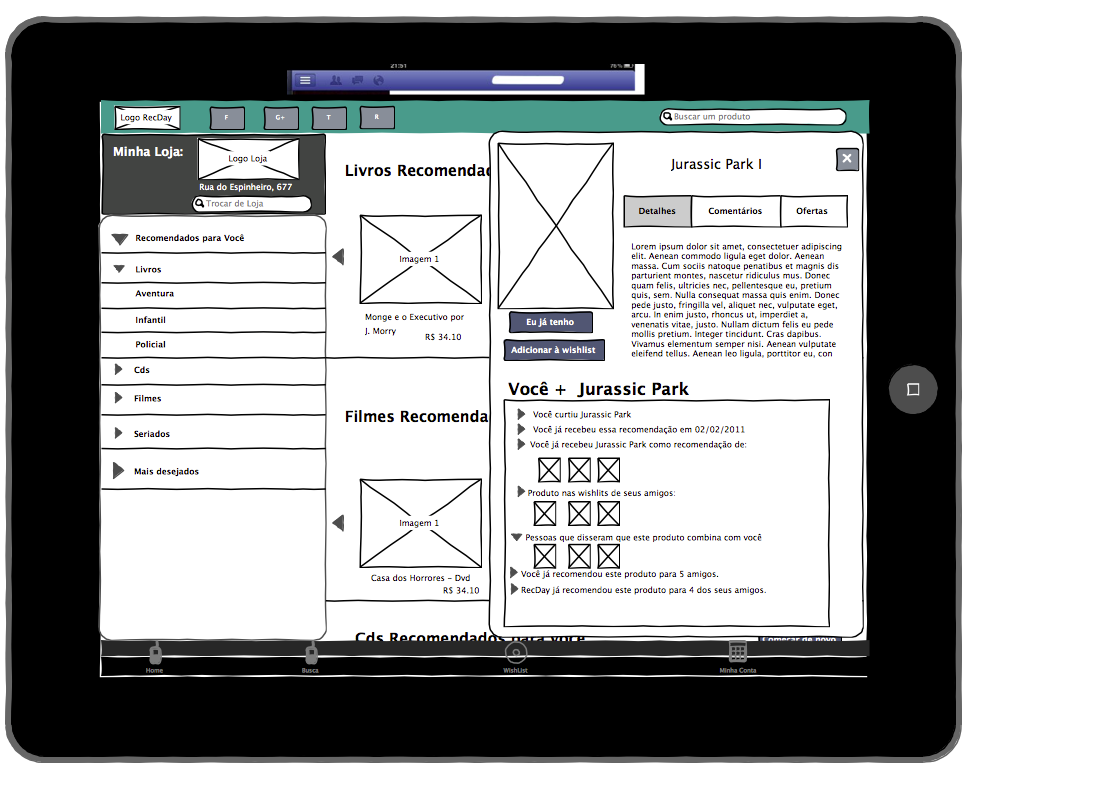
A particular medium of the recommendations: Ipad Demo

In order to build all these interesting technical challenges, we needed to start developing our in-house solution called Crab, which proccesses all this data and employ several analysis and filtering techniques  to deal with the percularities of this heterogeneous sources of data. The first start is the launch of the Deepjewel Labs. Deepjewel is a principle that we can mine the wealth in data, by identifying interesting entities and relationships and converting them into valuable information as input in the recommendation proccess of items and services. 

In summary, all those human and computation techniques can be used to perform a deep semantic analysis of web and social data, where the result for a commerce application or retail store is the ability to offer what the users want before they know that they really want in a personalized way. The RecDay  would be able to daily offer relevant product and services to their customers without they even know it exists. This is a new way to shop in which you don't have to go find products, service and information; the machine will help them find their way to you.

To know more about our Deepjewel labs, visit the website (currently in portuguese):  


I hope you enjoyed,

Marcel Caraciolo

Machine Learning with Python: Meeting TF-IDF for Text Mining

Monday, December 19, 2011

3Hi all,

This month I was studying about information retrieval and text mining, specially how to convert the textual representation of information into a Vector Space Model (VSM).  The VSM is an algebraic model representing the importance of a term (tf-idf) or even the absence or presence (Bag of Words) of it in a document. I'd like to mention the excellent post from the researcher Christian Perone at his blog Pyevolve about Machine learning and Text Mining with TF-IDF, a great post to read.

I decided in this post to be shorter and give some examples using Python . I expect at the end of this post you feel confortamble to use tf-idf at your tasks handling with text mining.

By the way, I extremely recommend you to check the scikit.learn machine learning toolkit. There is a whole package to work with text classification, including TF-IDF with Python!


What is TF-IDF ?

Term Frequency - Inverse Document Frequency is a weighting scheme that is commonly used in information retrieval tasks. The goal is to model each document into a vector space, ignoring the exact ordering of the words in the document while retaining information about the occurrences of each word.

It is composed by two terms: one first computes the normalized Term Frequency, which is the number of times a word appears in a documnet, divided by the total number of words in that document. Then, the second term is the Inverse Document Frequency, which is computed as the logarithm of the number of the documents in the corpus divided by the number of documents where the term ti appears. Or, in symbols:


and 


The TF-IDF gives how important is a word to a document in a collection, since it takes in consideration not only the isolated term but also the term within the document collection. The intuition is that a term that occurs frequently in many documents is not a good discriminator ( why emphasize a term which is almost present in the entire corpus of your documents ?)  So it will scale down the frequent terms while scaling up the rare terms; for instance, a term that occurs 10 times more than another isn't 10 times more important thant it.

For computing the TF-IDF weights for each document in the corpus, it is required in the corpus a series of steps:  1) Tokenize the corpus  2)  Model the Vector  Space  and 3) Compute the TF-IDF weight for each document in the corpus.

Let's going through each step:


Tokenization


First we need to tokenize the text. To do this, we can use the NLTK library which is a collection of natural language processing algorithms written in Python. The process of tokenizing the documents in the corpous is a two steps:  First the text is splint into sentences, and then the sentences are split into the individual words. It is important to notice that there are several words that are not relevant, that is, terms like "the, is, at, on", etc...  aren't going to help us, so in the information extraction, we ignore them. Those words are commonly called stop words and they are present in almost all documents, so it is not relevant for us. In portuguese we also have those stop words such as (a, os , as , os, um , umas, que, etc.)

So considering our example below:


We will tokenize this collection of documents and represent them as vectors (rows) of a matrix with |D| x F shape, where |D|  is the cardinality of the document space, or how many documents we have and the F is the number of features, in our example it is represented by the vocabulary size.

So the matrix representation of our vectors above is:


As you have noticed, these matrices representing the term frequencies (tf) tend to be very sparse (lots of  zero-elements),  so you will usually see the representation of these matrices as sparse matrices. The code shown below will tokenize each document in the corpus and compute the term frequencies.


Model the Vector Space

Now that each of the documents in the corpus has been tokenized, the next step is to compute the document frequency quantity, that is, for each term, how many documents that term appears in. Before going to IDF, it is important to normalize the term-frequencies. Why ?  Imagine that we have a repeated term in document with porpuse of improving its ranking on an Information Retrieval System or even create a bias torwards long documents, making them look more important than they are just because of the high frequency of the term in the document. By normalizing the TF vector we can overcome this problem.
The code.


Compute the TF-IDF

Now that you saw how the vector normalization was applied, we will now have to compute the second term of tf-idf: the inverse document frequency. The code is provided below:


The TF-IDF is the product between the TF and IDF.  So a high weight of the tf-idf  is reached when you have a high term frequency (tf) in the given document and low document frequency of the term in the whole collection. Now let's see the tf-idf computed for each term present in the vector space.

The code.


Putting everything together, the following code will compute the TF-IDF weights for each document. And the result matrix it will be:


A row of this matrix would be:


I ommited the zero-values elements of the row.

If we would decide to check the most relevant words for this place, by using the tf-idf I could see that the place has a nice hot chocolate drink (0.420955 <= chocolate quente ótimo), the soft drink nega maluca is also delicious (0.315716 - nega maluca uma delicia),  its Cheese bun is also quite good (0.252573 - pao de queijo muito bom).

And that is how we comput  our M_{tf\mbox{-}idf} matrix.  You can take a look at this link and this one to know how to use it with GenSim and Scikit.Learn respectively.

That's all,  I hope that  you enjoyed this article and help more people to know how to implement the tf-idf weight to mine your collection of texts.  Feel free to comment and make suggestions.

The source code of this example is also available.

Regards,

Marcel Caraciolo