Pages

Showing posts with label social media. Show all posts

Deepjewel - Social Media powering Recommendations

Wednesday, January 4, 2012

Hi all,

Happy new year!  My first post this year will be about an idea that I had with my friend Ricardo Caspirro about the next generation of social recommenders in commerce applications and retail stores. What excites me is that this idea came from a conversation that we had in 2009, and since that year we discussed more about what it would be the "Deepjewel".

Deepjewel is a giant knowledge base that encapsulates interesting entities and relationships of the social world in the web.  The social world in this context means all the millions and billions of tweets, Facebook messages, profiles, relationships, blog posting, YouTube videos, and more - a living organism itself, constantly evolving. 


The Deepjewel

But what motivated us to create the Deepjewel?  One of main problems that we face nowadays is the discovery of content and items of our interest.  Many times, for instance, to find a book or a movie that we like, it is required to search at several websites and social networks through the web.  There isn't a tool that allow this connection between items of many domains in a organized and structured way, even for easy access. Those objects are spread over the web, and the recommendations are placed in social networks by comments, results of machine learning techniques or by queries at several web pages or search engines.  The problem becomes worst when we don't know anything about the existence of a certain item, which it could result at never finding out that possible item that would be of our interest. 

The social media is huge and we need tools that performs a deep analysis of all this data, filter out items of my interest, specially from the historical data  (with our permission, of course)  from our presence in the web and bring items and products relevant to us without loosing the discovery process associated with the serendipity.  One of the solutions is a powerful recommender engine fed by this Social Genome.


Hybrid Social Context-Aware Recommender RecDay


This hybrid social context-aware recommender (which we call recday) is a engine composed by several modular components, which we employ a broad range of semantic analysis techniques, including information extraction and integration, natural language processing and machine learning. The main task of this recommender is to analyze information about his posts, bios and relationships/lists collected from the social genome and summarize it (all this data would represent the interests of the user) in profiles, which we could call DNA. Those profiles built by the recday would infer the possible interests of the users and would serve as basis for personalized recommendations of products and services from the retail stores/e-commerce applications.


A perfect example for this proccess, which we call the translation, is when you mentioned several times about Apple products (such as macbook, ipod, iphone, etc) at your tweets. Even you never used the word "Apple", we can use the Social Genome to detect the products and infer that you are interested in Apple products. The following figure illustrate certain kinds of entities and relationships collected in the Social Genome:


The relationships extracted from the social web data

The second step of this engine is to build the user profile. Different from another approaches which it only uses the content or the historical data from reviews or ratings from the user, the Recday would go further and would analyze the temporal context included in the interests of the user. Several reports on consumer behavior show that the user desires are influented by external factors and even the humour or feelings of the person at the certain moment. It is required to collect in a stealth way (with the user permission of course) his social data and build his personality defined by several dimensions. Those dimensions represent the current state of the user which may define what kind of suggestions he would like to receive at that particular moment. For example, if you are happy today because you got a new job and posted at your Facebook about that event or even updated your profile about this new position, it would be a valuable information for your DNA profile in order to recommend products and services to celebrate this occasion (You are happy and excited, don't you think ?).

Another important component in this proccess is the product side. We need extract more information from their products portfolio. Items must be juiced in order to get all its meta-data available. Imagine the movie Batman where we have details about the year, genre, cast, production, direction, sinoypsis, etc. All this data can be used to build the DNA Item and be expressed by a collection of dimensions that represent the item profile. With those profiles (DNA User and DNA Item) we compute the similarity between user and items in order to produce a list of top recommendations and related explanations.


The Social Architecure of the Recommender


The final result can be shown in several mediums: mobile apps, widgets, web, API's, pluggins, etc. It is important the usability and how you will present all this information for a particular user. That's why the user interface must be simple and easy to navigate and have mechanisms to collect the user's feedback for the suggestions given by the engine. This proccess is cyclic, so when you give a feedback (a like or dislike or a comment about the suggestion), this piece of information is handled and leveraged to power your DNA profile.
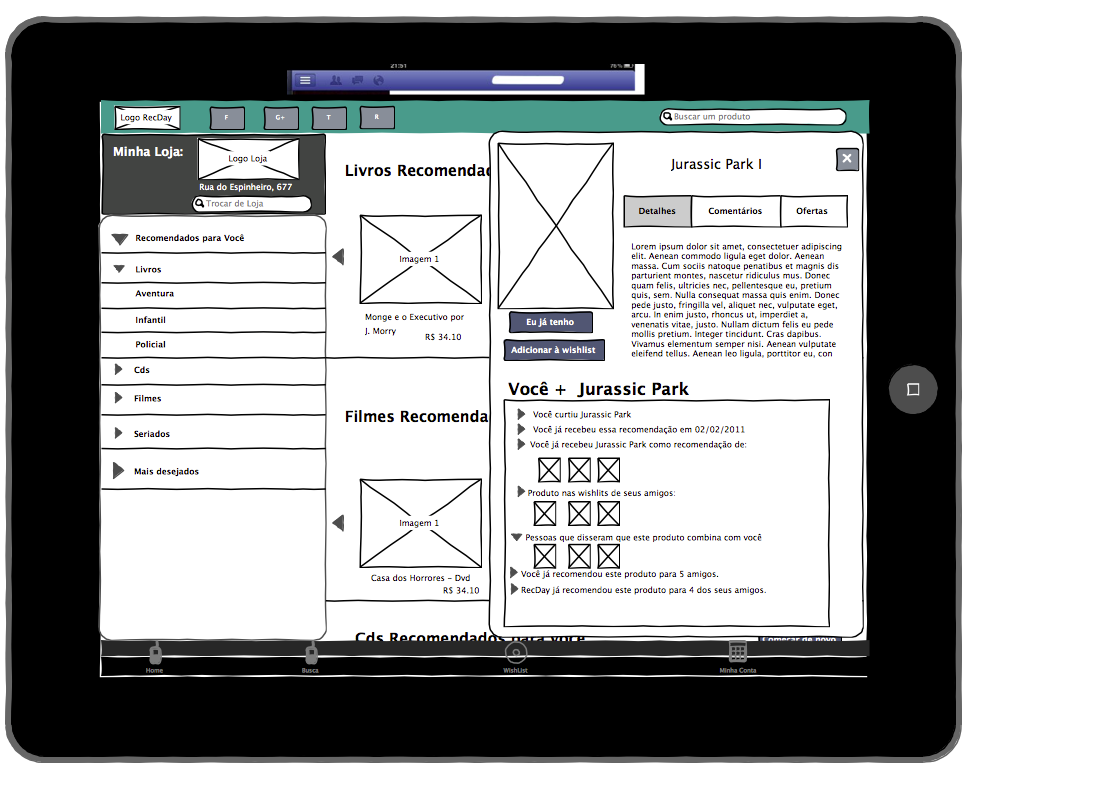
A particular medium of the recommendations: Ipad Demo

In order to build all these interesting technical challenges, we needed to start developing our in-house solution called Crab, which proccesses all this data and employ several analysis and filtering techniques  to deal with the percularities of this heterogeneous sources of data. The first start is the launch of the Deepjewel Labs. Deepjewel is a principle that we can mine the wealth in data, by identifying interesting entities and relationships and converting them into valuable information as input in the recommendation proccess of items and services. 

In summary, all those human and computation techniques can be used to perform a deep semantic analysis of web and social data, where the result for a commerce application or retail store is the ability to offer what the users want before they know that they really want in a personalized way. The RecDay  would be able to daily offer relevant product and services to their customers without they even know it exists. This is a new way to shop in which you don't have to go find products, service and information; the machine will help them find their way to you.

To know more about our Deepjewel labs, visit the website (currently in portuguese):  


I hope you enjoyed,

Marcel Caraciolo

Mining data from Web 2.0 and Location Web Services for Services Recommendation and Products Offer via Mobile media

Wednesday, April 14, 2010

Hi all,

It has been a while since my last post, but I've returned.  During this period, I was working on master thesis project plan (and finally decided what I will research and work on) as also lecturing a Python training course for a company here at Recife - Brazil. In this post, I will talk more about what I'm planning to do at my master thesis and present some concepts related to Mobile Marketing, Web, Services, Social Media and Recommendation.

Web  2.0  and Location Web Services [ Photo from blog Arrobazona]

Here, I present a resume of my master degree plan.

With the advent of the latest Web 2.0 technologies [1] and social activities ocurring all over the world, more and more people are sharing information and building relationships. They're taking a important role in part of our lives as helping to answer critical questions such as 'what' , 'how', 'where', 'where', 'why' and 'who'.  However, regardless of these questions, one critical issue is how to give all those answers (information) effectively and recommend in a way that may interest people.

One of the possible targets for these activities are the mobile phones. They are a perfect recipient for fetching a variety of data from mobile information like location and ubiquitous content like small text messages, photos, etc. The new generation of multimedia mobile phone, like Iphone, has begun to integrate online web services and location data acquired from location providers such as  Global Positioning System (GPS) and mobile networks.  These new services formed a known and independent research area name as Location Based Services (LBS)[2] [3].  A perfect example of LBS is the Google Maps [4], which aims to help mobile users access to their destinations with real-time traffic information and road conditions. 

Futhermore, the  GPS software vendors, mobile operators and content providers have also gradually to try for the mobile terminal application development. With content created by combining GPS location-based services and latest Web 2.0 technologies (blogs, tagging, comments, social networks, etc.)  it would be possible to provide timely and personalized information and sharing services based on the user's location information. Or even more, use the content provided of the mobile user, to inform the vicinity of restaurants, entertainment and shopping information, etc.

If we look at the existing location-based services,  such as Foursquare [6], Yelp [7] , Gowalla [8] and others, its information is derived from a single content providers (such as map makers or service providers) so there are some relevant limitations [5].  Based on the traditional information retrieving, the location-based-services and companies are giving more emphasis on the dynamics of information and diversity more than the real-time and targeted content services.  Although, the  users want to be able to obtain contextual and identifying content, not just the indexed information based simply on a static database.  

Recently, those LBS services are looking to how to improve their systems by using some game components and   foucusing on the user experience and engagement with augmented-reality functionalities [9]. However, the rise of a large number of Web 2.0 applications (blogs, microblogs, Taggins, forums, Web albums, etc.) indicates that the users have the urgent requirements of direct, fast, useful and personalized information recommendation and sharing services.

So there is a big question here: How to efficiently combine new Web 2.0 applications (Twitter, Facebook, etc.) with location based services and apply to mobile phone ?  Since there are heterogeneous data and services in various formats and different application platforms, how to integrate all this data that can be used as platform-transparency specially for the user? And how to display all this information in a limited display screen of mobile devices, without prejudicing the usability and  the associated costs for the traffic data. Finally,  how to deploy a mobile discovery content  provider by identifying the user preferences and his location in a intelligent way ?

Those questions are doubtless part of a important research topic, and will have a very wide market prospect. Creating mobile advertisements to target a specific audience and a group of users is also one of the challenges in this area and in the Mobile Marketing research field.

Considering the previous statements, my proposal is to study the use of data mining techniques and recommendation engines in order to develop a  recommender system  integrated with Web technologies and location web services in the mobile enviroment. To solve that I will apply a variety of data analysis tools, algorithms to discover valid, novel, potentially useful and understandable patterns and relationships in data.  Design and implement a collaborative recommender algorithm that can analyze the user value-added data obtained from many Web 2.0 applications. Finally,  prototype a location-based data and service middleware based on web services protocols (SOA) to group all this heterogeneous data and services and publish them as one transparent-platform web service. Atacking those fields, I believe at the end of this project, to develop a real case demo and present a complete tool set for mobile data analysis.

That's all, There are many important topics to research and a lot of work to do. My aim is to build a recommender system for events/places/users using data from Twitter/Foursquare and Yelp and other possibility for recommend/offer products in ubiquitous enviroments with prices, items and shopping advertisements. I believe that there's a incredible and promising to research, specially with the  rise of new mobile social web services.

Best regards,
Marcel Caraciolo

References

[1] Tim O'Reilly (2005-09-30). "What Is Web 2.0". O'Reilly Network. 
 http://www.oreillynet.com/pub/a/oreilly/tim/news/2005/09/30/what-is-web-20.html.

[2]  Shiode, N., Li, C., Batty, M., Longley, P., & Maguire, D. The impact and penetration of  location-based services. In H. A. Karimi & A.  Hammad (Eds.), Telegeoinformatics:  location-based computing and services, 2004,  pp. 349–366, CRC Press.
[3] Jiang, B., Yao, X. B. Location-based services  and GIS in perspective. Computers, Environment and Urban Systems,Vol.30, No.6, 2006, pp. 712-725.

[4] Google.  Google Maps . At http://maps.google.com

[5] Li, C. User preferences, information transactions and location-based services: A  study of urban pedestrian way finding. Computers, Environment and Urban Systems, Vol.30, No. 6, 2004, pp.726–740.

[6] Foursquare.  Foursquare:. At http://www.foursquare.com

[7] Yelp.  Yelp:. At http://www.yelp.com

[8] Gowalla. Gowalla At http://www.gowalla.com

[9] Maria R. Ebling, Ramón Cáceres, "Gaming and Augmented Reality Come to Location-Based Services," IEEE Pervasive Computing, vol. 9, no. 1, pp. 5-6, Jan.-Mar. 2010.