Pages

Showing posts with label artificial intelligence. Show all posts

Guide to Recommender Systems Book Online

Friday, February 24, 2012


Hi all,

This year one of my goals is to write a book such as a guide to teach recommender systems for programmers. I know there are several textbooks that focus on providing a theorical foundation for recommender systems, and as result, may seem difficult to understand. For programmers that want to learn how to start to use or understand the components of a recommender system, this book is what they are looking for.  

This guide follows a learn-by-doing approach. Therefore, I will use theory and apply it through the exercises and experiment with Python code.  I hope when you complete the book you will be able to understand how to build a recommender system and give you the first steps to apply them at your own systems. The textbook is laid out as a series of small steps that will guide you for undestanding the recommender system techniques. 

This book is available for download for free under a Creative Commons license. This project is also leaded by my colleague Ricardo Caspirro, who will review and translate it to portuguese language.

Below I provide the table of contents of the book.


Guide to Recommender Systems


The link for the online guide is available here.


http://muricoca.github.com/recommendation-lectures/index.html


Table of Contents


Chapter 01: Introduction to Recommender Systems

Finding out what recommender system is and what problems it solves. And a fast review of what you will be able to do when you finish this book.

Chapter 02: Collaborative Filtering

This chapter focus on how you can use the state-of-the-art techniques of collaborative filtering that makes automatic predictions (filtering) about the interests of a user by collecting preferences or taste information from similar users (user-based) or similar items( item-based).


Chapter 03: Content Based Filtering
Recommender systems that  suggest an item to a user based upon a description of the item and a profile of the user's interests. Although thedetails of various systems differ, content-based recommendation systems share in common a means for describing the items that may be recommended, a means for creating a profile of the user that describes the types of items the user likes, and a means of comparing items to the user profile to determine what to recommend. 


Chapter 04: Hybrid Based Filtering
This chapter will focus how to pick the best features of collaborative and of content and mix them to build hybrid recommender systems. It will present the current work on this field and an example of  how it works and how you can decide the best strategy to select.

Chapter 05:  Model - Based Recommenders
Techniques that will include memory-based techniques or data mining techniques such as association analysis, symbolic data analysis and classification/clustering techniques will be covered in this chapter.

Chapter 06:  Evaluation of Recommender Systems
This chapter starts with a short description on how to evaluate the recommender systems and the commonly used metrics for compare the recommender algorithms in the development and deployment stages.

Chapter 07:  Recommender Systems and Distributed-Computing
Recommender Systems suffer with sparse matrices where the user x items preferences are sparsed (lots of missing values - preferences). It results on large datasets with millions of items, users and preferences.  For this task it is considered to use distributed computing techniques such as map-reduce to distribute the recommendations. This chapter will cover those topics.

Chapter 08:  Study Case
It will present a study case of a mobile recommender system for recommend users to another users using several techniques showed above and how we tested and deployed it.

Chapter 09:  Recommender Systems the Next Generation
This chapter brings the next generation of recommender systems, describing what the research is going after in several fields such as ubiquity, semmantics, etc.

Chapter 10:  Meeting Python-RecSys Framework
It will present the Python-RecSys framework for building recommender systems with Python in a easy way. It will describe how to build or test already implemented techniques or develop new ones and deploy them with frameworks Web and REST.


This book is under development, please let me know if there are any suggestions or corrections to make over one of those chapters. If you see that there is a topic that needs an extra chapter or a topic that I am missing, please also let me know and comment.


I hope you enjoy this work, specially the developers!


Regards,

Marcel Caraciolo

Deepjewel - Social Media powering Recommendations

Wednesday, January 4, 2012

Hi all,

Happy new year!  My first post this year will be about an idea that I had with my friend Ricardo Caspirro about the next generation of social recommenders in commerce applications and retail stores. What excites me is that this idea came from a conversation that we had in 2009, and since that year we discussed more about what it would be the "Deepjewel".

Deepjewel is a giant knowledge base that encapsulates interesting entities and relationships of the social world in the web.  The social world in this context means all the millions and billions of tweets, Facebook messages, profiles, relationships, blog posting, YouTube videos, and more - a living organism itself, constantly evolving. 


The Deepjewel

But what motivated us to create the Deepjewel?  One of main problems that we face nowadays is the discovery of content and items of our interest.  Many times, for instance, to find a book or a movie that we like, it is required to search at several websites and social networks through the web.  There isn't a tool that allow this connection between items of many domains in a organized and structured way, even for easy access. Those objects are spread over the web, and the recommendations are placed in social networks by comments, results of machine learning techniques or by queries at several web pages or search engines.  The problem becomes worst when we don't know anything about the existence of a certain item, which it could result at never finding out that possible item that would be of our interest. 

The social media is huge and we need tools that performs a deep analysis of all this data, filter out items of my interest, specially from the historical data  (with our permission, of course)  from our presence in the web and bring items and products relevant to us without loosing the discovery process associated with the serendipity.  One of the solutions is a powerful recommender engine fed by this Social Genome.


Hybrid Social Context-Aware Recommender RecDay


This hybrid social context-aware recommender (which we call recday) is a engine composed by several modular components, which we employ a broad range of semantic analysis techniques, including information extraction and integration, natural language processing and machine learning. The main task of this recommender is to analyze information about his posts, bios and relationships/lists collected from the social genome and summarize it (all this data would represent the interests of the user) in profiles, which we could call DNA. Those profiles built by the recday would infer the possible interests of the users and would serve as basis for personalized recommendations of products and services from the retail stores/e-commerce applications.


A perfect example for this proccess, which we call the translation, is when you mentioned several times about Apple products (such as macbook, ipod, iphone, etc) at your tweets. Even you never used the word "Apple", we can use the Social Genome to detect the products and infer that you are interested in Apple products. The following figure illustrate certain kinds of entities and relationships collected in the Social Genome:


The relationships extracted from the social web data

The second step of this engine is to build the user profile. Different from another approaches which it only uses the content or the historical data from reviews or ratings from the user, the Recday would go further and would analyze the temporal context included in the interests of the user. Several reports on consumer behavior show that the user desires are influented by external factors and even the humour or feelings of the person at the certain moment. It is required to collect in a stealth way (with the user permission of course) his social data and build his personality defined by several dimensions. Those dimensions represent the current state of the user which may define what kind of suggestions he would like to receive at that particular moment. For example, if you are happy today because you got a new job and posted at your Facebook about that event or even updated your profile about this new position, it would be a valuable information for your DNA profile in order to recommend products and services to celebrate this occasion (You are happy and excited, don't you think ?).

Another important component in this proccess is the product side. We need extract more information from their products portfolio. Items must be juiced in order to get all its meta-data available. Imagine the movie Batman where we have details about the year, genre, cast, production, direction, sinoypsis, etc. All this data can be used to build the DNA Item and be expressed by a collection of dimensions that represent the item profile. With those profiles (DNA User and DNA Item) we compute the similarity between user and items in order to produce a list of top recommendations and related explanations.


The Social Architecure of the Recommender


The final result can be shown in several mediums: mobile apps, widgets, web, API's, pluggins, etc. It is important the usability and how you will present all this information for a particular user. That's why the user interface must be simple and easy to navigate and have mechanisms to collect the user's feedback for the suggestions given by the engine. This proccess is cyclic, so when you give a feedback (a like or dislike or a comment about the suggestion), this piece of information is handled and leveraged to power your DNA profile.

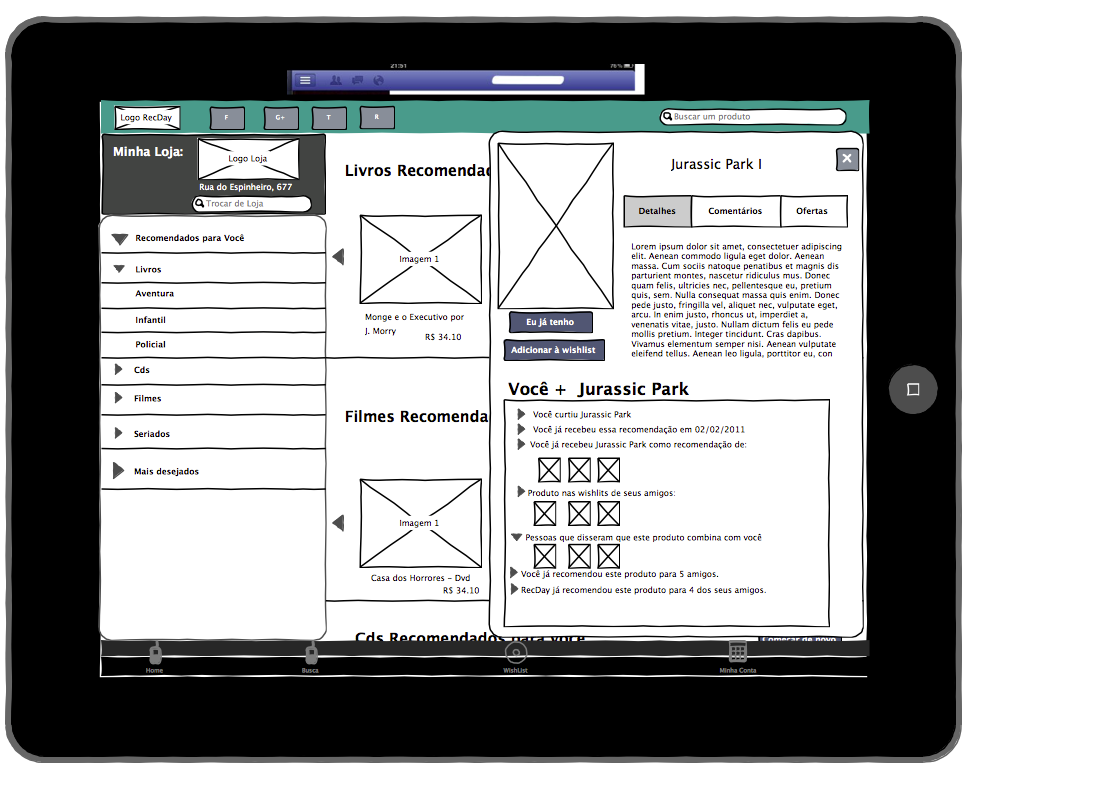
A particular medium of the recommendations: Ipad Demo

In order to build all these interesting technical challenges, we needed to start developing our in-house solution called Crab, which proccesses all this data and employ several analysis and filtering techniques  to deal with the percularities of this heterogeneous sources of data. The first start is the launch of the Deepjewel Labs. Deepjewel is a principle that we can mine the wealth in data, by identifying interesting entities and relationships and converting them into valuable information as input in the recommendation proccess of items and services. 

In summary, all those human and computation techniques can be used to perform a deep semantic analysis of web and social data, where the result for a commerce application or retail store is the ability to offer what the users want before they know that they really want in a personalized way. The RecDay  would be able to daily offer relevant product and services to their customers without they even know it exists. This is a new way to shop in which you don't have to go find products, service and information; the machine will help them find their way to you.

To know more about our Deepjewel labs, visit the website (currently in portuguese):  


I hope you enjoyed,

Marcel Caraciolo

Google AI Challenge this year is open! Ants Battlefield!

Friday, November 4, 2011

Hi all,

One more time Google and the University of Waterloo's computer science club have launched an Artificial Intelligence challenge. This year the task is to write a program to compete in the Ants Multiplayer Challenge. The goal is seek and destroy the most enemy ant hills while defending their own hills.  You must create a bot that plays the game of Ants as intelligently as possible.  The contest supports languages in Python, Java, C# and C++.

The current state of the contest, which you can submit your project, is until December 18th. After, there will be a final tournament between the contestants to decide the ultimate winner!

See  the game in action at the video below.


It is a great opportunity to learn Artificial Intelligence and play with your skills at programming, machine learning and logical reason!

Regards,

Marcel Caraciolo  


Mobile Recommenders and current challenges

Monday, June 27, 2011

Hi all,

It has been a while that I've been studying about recommendation engines and how can they be applied on mobile apps.   More and more data is exchanged between those platforms. Great examples of mobile apps that are using recommender engines are Google Hotpot  and Foursquare. They not only connect people to each other, but help users discover places around them.

Bizzy: A mobile recommender for Places

However, they only scratch the surface in this field, which is considered a novel research area in recommender systems. There are  several topics to be explored such as:

  •  The location-based recommenders suggest items based on how far away we are from them (sometimes this can be manually changed). This could be a problem, if you consider the distance as the main factor for your recommender. Let me explain with an example. Imagine that you receive music concerts recommendations from your app around your in radius of 2km. When you're looking for live music, there's a band playing 1 km which will be recommended, but your favorite band, which is playing 2.1 km aways, will be out of the final list. And worst, if my  favorite band will play tomorrow and I am at home looking for recommendations, it won't be suggested in this case because of the distance.  It is necessary those systems to consider our habits in order to provide recommendations based on the most checked-in places that I visit (one possibility).
  • The mobile recommenders must consider the context where the users are inserted. However the recommenders currently must receive what people are looking for, before receiving the suggestions. Wouldn't be interesting to consider the time events or even the historical habits ? Are those factors enough ?
  •  The information about the location and place (content) is also important in the recommendation computation. Imagine you exploring places around you at Foursquare and there are trending places around you (lot's of people there). This recommendation will be received considering only distance ? It is necessary to consider the temporal information associated to the place.
  • Just because I've been many times at the Nipon's Sushi , it doesn't mean that I don't want to receive the recommendation again. The process of discovery and re-discovery is important either. The current systems, in general, don't consider the user's familiarity with the locations the user frequent.
  • Venues are venues. Events are the "main" item interested by the user, not the venue. Ok, I like receiving a recommendation of a place, but sometimes I'd like to know what's happening there. Furthermore, the current check-ins and rating systems reflect what's happening now, but not what I am planning in the future. The discovery process and prediction decision are main important issues when you're designing a mobile recommender, specially dealing with temporal short-life like events.
  • Noisy data. Recommendations of "my apartment", "my mother house". Recommendations can suffer with those types of places.
  •  How do we collect the data ? It will be by check-ins, 5 *scale ? Or passive using GPS ? This brings issues about the recommendation interface and how the data will be influenced by the social-signalling noise.
  • Some systems use the user's search history to recommend places. This can be noisy, considering that sometimes that what the user searches online often do not match what the user needs when he wants to go out. Just because I looked for information about the Recife airport, it does mean that I'd like to receive airport recommendations.  The point is: the relevance of places that you search for online doesn't match places that you would like to discover in the real world.
Those are some of several challenges faced by mobile recommenders. Mobile recommender systems are still growing and there's lots of research around it.  But one important observation to make is that the best techniques for recommenders in the web sometimes are not suited for mobile recommenders. It's required that the recommendation designer be able to balance between the distance and the preferences from the user and the related items, understand the context where the user is inserted and help him to discover and re-find places and events hidden in his city!

There will be a workshop during the ACM Recommender Systems 2011 about mobile recommenders. Unfortunately this year I won't be attending , but it is on my plans! By the way, you still can submit your paper until July's 25th!

PS: I've found this great blog about mobile recommendations and mobile data mining : Urban Mining. I recommend!

PS2: Recommended reading about why people check-in. An interesting research about why people are interested in checking-in mobile applications.

I hope you enjoyed this article,

Marcel Caraciolo

Crab: A Python Framework for Building Recommendation Engines

Sunday, May 8, 2011

Hi all,

In this weekend I presented a lecture at the XII Python User Group Pernambuco Meeting about the framework I've been working on at these last months. The framework is called Crab and it is a Python library for building recommendation engines. Its main goal is to be an alternative for machine learning researchers and developers for use standard-of-the-art implemented recommendation algorithms, evaluate and extend it by building new techniques using the basic core provided by the framework.   

Me presenting the Crab : A Python framework for building recommendation engines

The framework has started in 2010, as a support toolkit for my master degree thesis about recommendation engines. I've implemented the Collaborative Filtering techniques as also the evaluation metrics used in recommendations (Precision, Recall, F1-Score, RMSE, etc). But since last month (April,2011) I decided to give the framework a shot to become more visible and bring more contributors for the project. The project became part of a Non-profitable organization called Muriçoca Labs, a team of  developers and researchers interested in Machine Learning and Artificial Intelligence. We also decided to    migrate all the core of the project using the scientific libraries Numpy, Scipy and Matplotlib, since the speed and the legibility of the code were the main advantages of these toolkits.   

The project started last month and had its first sprint where the team is focused on rewriting all the code of the old crab to this new release as also make it a independent project member of the Scikit repository - Sub-projects of Scipy Framework and a sub-module of the Scikit-Learn  (a popular python framework for machine learning algorithms). 

We are quite excited and working harder! By the way the Crab framework is already in production providing the recommendations of the brazilian social network AtePassar.  We are with lot of ideas and features such as content based filtering algorithms, recommendations as services providing REST APIs and Databases Models Support.

If you are interested in the project and want to know how to join us or use our projects, please let me know and add a comment below and I will be glad to help you!  The project is at the beginning, but we are working harder to see it in action as a possible alternative for Python developers that want to work with this hot topic in the data mining and web services: Recommender Systems.

Below I provide the slides that I presented about the project at the lecture.


Meet the Muriçoca Labs here  and the link for the Crab framework here.

Regards,

Marcel Caraciolo

Providing Recommendations in Social Networks using Python: AtePassar Study Case

Monday, March 14, 2011

Hi all,

Recently I've been working on recommendations, specially related to social networks. One of my tasks is to investigate, create and analyze a recommendation engine capable of generating suggestions of friends,  study groups, videos and related content to a registered user in a social network.

The social network that I am working on is called AtePassar, a brazilian social network for people who wants apply for positions at brazilian civil (government) services.  One of the great features of this social network is because people can share their interests about studies and meet people all around Brazil with same interests or someone that will apply for the same exam as him.  Can you imagine the possibilities ?

It is a social network for students into a virtual space where there are several relations of friendship, studies and even exam partners.

AtePassar Social Network


Since we believe in interaction between people and discovering of relevant content a real need for users inside a social network, specially finding tasted-like users which indicate the similarity of their needs and opinions,  we decided to build a recommender system capable of recommending new users based on similar interests such as common friends,  common videos both have watched or study groups where both have joined in, etc.   We  also have developed a study group recommender, which suggests relevant  study groups based on the friends' study groups that they are participating and the active user is not.  Finally, we also have developed a video recommender,  providing suggestions for classes (on-line video classes) relevant for the users based on what his friends has already watched.

As you may have noticed that we focus on more in the collaborative filtering process, where we are more interested on finding similar users and bring unknown items closer to the active user's historical preferences  as possible recommendations.


Recommendations SideBar

One of our priorities in this recommendation process is to always explain to the users the reason of the recommendation is presented to them.  We believe it is really important for the user to know the relevance of the recommendation and even for us to improve the level of acceptance of the recommendation.  If you receive a recommendation and that recommendation is joined with extra information that 4 friends of you also liked that item, it can be more meaningful than only receiving the recommendation without knowing the reasons.

Another priority for us is to provide recommendation to all users, even new users who has started using the AtePassar network and don't have sufficient information in his profile (friends, studygroups, etc) to bring relevant recommendation. I've developed a simple algorithm that it is a solution for this common problem in recommendations called 'cold start'.  Cold Start happens specially for new users, where there is not enough user and item information and therefore it's hard for the recommendation system to produce recommendations. We decided to bring the most accepted recommendations from users in our social network (the most popular) and populate them as possible suggestions for new users.  We know this is not the best solution, because it is not personalized, but it can bring recommendations out-of-the box in cases where we are newbies in the social network.


We are doing a poll to know from Atepassar users to know more about whether they are liking the suggestions our system is providing.  More than 60% of the ones who have answered the poll said that they like most of suggestions provided.  We are working harder to even improve this recommendation process bringing more content to be recommended and the utility by considering extra information in the user's profile.

Here a brief introduction (video) to the social recommender engine running at AtePassar Social Network.


In the next posts I will bring more information in a detailed view of development and explain more about recommender engines, the area I am working on also in my master thesis. I've been using also a open-source recommendation engine in this work, it is beginning but we are improving in small steps bringing new releases every month.   Until now, our framework called Crab is only working for Collaborative-filtering  recommendations (written in Python) and we are planning for the next releases bring Content-based ones and distributed algorithms  using map-reduce features, etc.

If you want to take a look at our recommendation engine, please check it out here in this link (It is hosted in my personal GitHub repository).  In a previous post in my blog I introduced the framework and I am planning to write a series of posts to deep into recommendation engines, explaining on how to use it, evaluations, etc.

I also wrote an introduction for recommendation engines if you're starting now in this machine learning field. You can check it out here.

I hope you enjoyed,

Marcel Caraciolo

Developing a Computer-Assisted Twitter User . Meet @caocurseiro !

Wednesday, December 29, 2010

Hi all,

It has been a while since my last post but the reason is that I've been working in some new stuff related to social recommendation and at my master thesis. But this post is to talk about a recent project that I developed for a brazilian social network called AtePassar.  AtePassar is a brazilian social network for people who wants apply for positions at brazilian civil (government) services.  One of the great features of this social network is because people can share their interests about studies and meet people all around Brazil with same interests or someone that will apply for the same exam as him.  Can you imagine the possibilities ?

AtePassar  Main Page

It is a social network for students into a virtual space where there are several relations of friendship, studies and even exam partners. All the network services are free for the users and there is also a e-commerce store where the users can buy resources for helping them in their studies like video lectures, papers, books, etc. My current job there is to apply intelligence in the social network, specifically collective intelligence. Right now I am working in a big project for a social recommender at AtePassar (it will be soon posted here explaining how I managed to build it) and small projects for helping the social network to fetch more new users.   

One of them that I'd like to comment is the new Twitter Bot that I developed that tries to simulate a human, specifically controlling all the actions of a twitter account.  Let me explain more about it.  The goal is not to develop a SPAM bot or a bot that only talk about specified terms.  I imagined it as a bot that could post new updates about open public positions at Brazil, self-helping quotes for stimulating people and simple mentions related to the AtePassar. Also it would retweet tweets from another users that speak about open public exams in Brazil, send mentions to people that are interest about those subjects presenting them the AtePassar social network and even following those users.

Written in Python and hosted at Google AppEngine I created the bot @caocurseiro, who is the mascot of the social network. What does it do ?
  • Post 1 to n updates in a random time set by a interval defined by the administrator.
  • Send 1 to n mentions to new users  (@newuser) in a random time set by a interval defined by the administrator
  • Follow 1 to n new users in a random time set by a interval defined by the administrator
  • Retweet 1 to n tweets in a random time set by a interval defined by the administrator.
Of course, since the Twitter politics is against at all kinds of SPAM, I developed this bot to obey the rules and the rare limits established by them.  Other feature is that  he even sleeps during the night (our Brazilian local time)  for a random period.  I am still thinking how to improve it by answering mentions when is directed to him and improve the quality of the posts that sometimes come repeated.

It has been online for about two days our mascot and he's already following 42 users and it's followed by 25 users.  As soon as I put a new retweets rules which it would retweet posts from another users about  subjects related to open public exams and related stuff, I think it will improve much more the quality of the bot.

Unfortunately the code is not yet open-source, but I am working on it to provide it as open-source.  I think the biggest contribution is how to develop a computer driven Twitter User to be similar as human user as possible. Although he still uses static rules, maybe I could put some intelligence to him by answering real questions about any open public exams at Brazil ( future ideas).

Caocurseiro Twitter Computer's Driven

That's all,

Marcel Caraciolo

Recommender Engines and Data mining with Python at PythonBrasil Conference

Thursday, October 28, 2010

Hi all,

Last week I was at an important event in Curitiba called Python Brasil. It is a annual event where it joins several brazilian developers to discuss about technology and of course about the programming language Python.

I also had the opportunity  to lecture three presentations about several topics of my interest.   The official presentation was about recommendation engines with Python.  This work shows how developers could use python in developing recommendation engines with several examples and explaining the main concepts behind this subject.  The best part was the demos where I used real data from the web such as Twitter, to suggest users that are similar to me among the PythonBrasil followers.  The other example is based on collective buying, which i crawled some popular brazilian web sites and gathered real offers at Curitiba. The main idea is to recommend new offers according to my interests and what people similar to me also liked. It is the classical example of the collaborative filtering, commonly used at several e-commerces today including Amazon.
The presentation was great with lots of feedback.  If you want to take a look at the slides (it is on portuguese) please take a look here:


The main contribution of this work is a new library for building recommendation engines in Python language called Crab.  I've decided with some colleagues to develop this library in order to be a powerful tool for developers to use python as the main language to build and use classical recommender algorithms in their applications. Besides it is extensible so developers can add easily new algorithms to the engine. There is also a easy API so users can plug with their web apps running in different platforms such as Django, AppEngine, Web2Py, etc. 

If you want to collaborate or interest about this subject please feel free to join us at this work. The project is hosted at GitHub with the link:


My second presentation was a lighting talk. What's that ?  There is a extra category of presentations in PythonBrasil where you have 5 minutes to speak about any topic you want.  The one rule is 5 minutes, no more!   I was challenged so I one day before the presentation to develop a web crawler in order to scrap all the lectures submitted and approved at PythonBrasil conference.  With all this data in my hands I've decided to make an analysis to answer three questions in my mind:

a) Which are the main and  frequent topics showed at the keynotes at Python Brazil ?

b) Based on this information, how we could organize the speakers based on those topics ? That is group speakers with similar topics. A classical problem of clustering.

c) What information we could also extract such as level of expertise of the lectures, total time spent in the lectures, etc.


For all those questions I was seeking to answer I decided to use Python, Matplotlib and Ubigraph (A 3D Visualization tool for graphs).   It was really interesting because I really could find some groups based on similar interests.  The main subjects was Entrepreneurship, Hardware, Web, Design Patterns, Data Mining, Django and Artificial Intelligence.

With those subjects I could now group the speakers using a simple clustering algorithm such as K-means and organize them based what their topics were. I've recorded a simple video to present the result using the tool Ubigraph. Take a look:


The presentation in portuguese  you can see here:


In the end I think the event was awesome some great keynotes and of course lots of new contacts at my network.  I have to say it is a great opportunity to meet great people and share ideas and technology!

Next year it will be in São Paulo, Brazil. I expect to be there !

Best regards,

Marcel Caraciolo

Tools for Machine Learning Performance Evaluation: ROC Curves in Python

Tuesday, September 21, 2010

Hi all,

Continuing from the my last post about performance analysis on classification machine learning techniques, in this article I will talk about a specific analysis called Discriminatory Power Analysis by using Receiver-Operating Characteristic Curves  (ROC Curves).

First, let's review and introduce some concepts related to the classification problems. When we deal with systems that involves the detection, diagnostics or even the prediction of results, it is really important to check the obtained results in order to validate the discriminative power as good or not of a given analysis.  However only depending on the quantization of hits and misses on a test group does not really tell how good a system is, since it depends on the quality and distribution of the test group data.

For instance, let's consider a fraud detection system, which outputs are 1 or 0, indicating whether a transaction has been classified as a fraudulent or not.  Now suppose that we applied the system on a test group of 100 transactions which we already know which one was a fraud or not, and the system correctly identified 90% of conditions. Do you think it is a good performance, don't you ?

Actually it is not. One information is missing and it is how the test group was distributed.  Let's consider that actually 90% was fraudulent. The system, thus, could have considered  '1' to every input given, and still have achieved a 90% accuracy rate, as the 10% transactions left were not fraudulent. By now, we cannot be sure if the system was really good or worked as a random classifier considering everyone as fraudulent without any previous knowledge or calculations.

In this case, we have to consider another metrics in order to evaluate this unbalance in the test groups. As I said in a previous post in this blog about confusion matrix, it will act as a base for the measures used in the discriminatory power analysis in question.

Confusion Matrix

From this table, I will present some metrics used to help in this analysis.

1. Accuracy
It measures the proportion of correct predictions considering the positive and negative inputs.  It is highly dependant of the data set distribution which can easily lead to wrong conclusions about the system performance.

ACC =  TOTAL HITS/ NUMBER OF ENTRIES IN THE SET
          = (TP + TN) / (P + N)

2. Sensitivity

It measures the proportion of the true positives, that is, the ability of the system on predicting the correct values in the cases presented.

SENS = POSITIVE HITS/ TOTAL POSITIVES
           =  TP/ (TP+FN)

3. Specificity

It measures the proportion of the true negatives, that is, the ability of the system on predicting the 
correct values for the cases that are the opposite to the desired one.

SPEC  =  NEGATIVE HITS/ TOTAL NEGATIVES
           =  TN/ (TN +FP)
4. Efficiency

It is represented by the mean of Sensibility and Specificity.  The perfect decision would be  with 100% of specificity and 100% sensitivity. However this situation is rarely conceived, so a balance between both metrics must be obtained. This metric is a good evaluator for measure the responsiveness in a overall situation to the production of false positives and false negatives. Generally, when the system is too responsive to positive, it tends to produce many false positives and vice-versa.

EFF = (SENS + SPEC) /2

5. Positive Predictive Value
 
This measure indicates the estimation of how good the system is when making a positive affirmation. However it is not recommended to use it alone, causing easily to lead to wrong conclusions about system performance. It is the proportion of the true positives in contrast with all positive predictions.

PPV = POSITIVE HITS / TOTAL POSITIVE PREDICTIONS
         = TP / (TP + FP)
 
 6. Negative Predictive Value

This measure indicates the estimation of how good the system is when making a negative affirmation. However it is not recommended to use it alone, causing easily to lead to wrong conclusions about system performance. It is the proportion of the true negatives in contrast with all negative predictions.

NPV = NEGATIVE HITS / TOTAL NEGATIVE PREDICTIONS
         = TN / (TN + FN)

7. Phi (φ) Coefficient

It is a measure not commonly used and measure the quality of the confusion matrix in a single value which can be compared. For instance, if you have two binary classifications with same classes but with different sizes, it can be used to compare both of them. It returns a value between -1 and +1, where +1 represents a perfect prediction, 0 a random prediction, and -1 an inverse prediction.

φ =  (TP*TN - FP*FN) / sqrt( (TP+FP) * (TP +FN) * (TN+FP) * (TN +FN) )


Source Code

As I presented in the first post of this series, I've updated the confusion matrix by adding the new metrics presented above.

View the script at Gist.Github


The Receiver Operating Characteristic (ROC) Curve

The ROC curve was developed during the World War II and was extremely used by engineers to detect enemy objects in enemy fields. It became famous and widely used in other areas such as medicine, radiology, etc.  More recently, it has been introduced to the area of machine learning and dataming.

The main idea behind the ROC curves is to analyze the output from the classification systems, which are generally continuous.  Because of that, it is necessary to define a cut-off value (or a discriminatory threshold) to classify and count the number of positive and negative predictions (such as the fraudulent or legal transactions in the case of the statuses in bank transactions).  This threshold can be arbitrarily determined, so the best way to compare the performance of different classifiers is to select several cutoff values over the output data and study their effect.

Considering many thresholds, it is possible to calculate a set of pairs (sensitivity, 1-specificity) which can be plotted in a curve.  This curve will be the ROC curve for the system where the y-axis (ordenades) represents the sensitivity and the x-axis (abscissas) represents the complement of specificity (1 - specificity).

Examples of ROC Curves are presentend below.

classifiers
Examples of ROC Curves (From: CezarSouza's Blog)

As you can see in the figure above, higher the ROC curve's area, better the system.  This is a standard measure for classifiers comparison, which is called the area under the ROC Curve (AUC). It is evaluated by a numerical integration, such as, for example, the trapezoidal rule.

Now let's go to the development of a simple ROC curve in Python.  During a data mining project that I worked on last year, I decided to implement a ROC curve in order to analyze the performance of some classifiers.  This work resulted into a open-source library called PyROC which you can use inside your own applications for the creation, visualization and analysis of ROC curves.

Source Code

The project is hosted at my personal repository at GitHub.

Feel free to download the source code and use in your applications.


Using the code


To start using the code in your projects, just create a new ROCData object passing as argument the list of tuples containing the actual data, as measure by the experiment, and the predicted data as given by the prediction classsifier.  The actual data must be a dichotomous variable, with only two possible valid values. Generally it is assumed the values 0 and 1 for represent the two states. For the test data, given by the classifier their values must be continuous and the range between the highest and lowest values considered in the actual data. For instance, if the values are 0 and 1, the test data values must be inside the [0,1] range.

from pyroc import *
random_sample  = random_mixture_Model()  # Generate a custom set randomly
print random_sample[(1, 0.53543926503331496), (1, 0.50937533997469853), (1, 0.58701681878005862), (1, 0.57043399840000497),
(1, 0.56229469766270523), (1, 0.6323079028948545), (1, 0.72283523937059946), (1, 0.55079104791257383),
(1, 0.59841921172330748), (1, 0.63361144887035825)]
 
To compute the area under the curve (AUC) and plot the ROC curve just call the RocData object's methods auc() and plot() . You can also pass the desired number of points to use  for different cutoff values.

#Example instance labels (first index) with the decision function , score (second index)
#-- positive class should be +1 and negative 0.
roc = ROCData(random_sample)  #Create the ROC Object
roc.auc() #get the area under the curve
0.93470000000000053
roc.plot(title='ROC Curve') #Create a plot of the ROC curve
Some metrics are also available evaluated from the confusion matrix such as accuracy, specificity, sensitivity, etc.


#threshold passed as parameter - the cutoff value. (0.5) 
roc.confusion_matrix(0.5)
{'FP': 18, 'TN': 82, 'FN': 18, 'TP': 82}
roc.confusion_matrix(0.5,True)
         Actual class
        +(1)    -(0)
+(1)    82      18      Predicted
-(0)    18      82      class
{'FP': 18, 'TN': 82, 'FN': 18, 'TP': 82}
r1.evaluateMetrics(r1.confusion_matrix(0.5))
{'ACC': 0.81000000000000005, 'PHI': 0.62012403721240439, 'PPV': 0.81632653061224
492, 'SENS': 0.80000000000000004, 'NPV': 0.80392156862745101, 'SPEC': 0.81999999
999999995, 'EFF': 0.81000000000000005}


At least if you wanna plot two curves in the same chart, it is also possible by passing a list of RocData objects. It is useful when you want to compare different classifiers.

x = random_mixture_model()
r1 = ROCData(x)
y = random_mixture_model()
r2 = ROCData(y)
lista = [r1,r2]
plot_multiple_roc(lista,'Multiple ROC Curves',include_baseline=True)
 

There is also another option for you to use the script : stand-alone. Just run at the terminal the command below to see  the available options.

Run at your terminal python pyroc.py


Demonstration


Let's see some ROC curves plotted in action.


 I've finished the second part of the performance analysis on machine learning classifiers. This is a simple introduction, so if you want a better understanding of how ROC curves work and its meaning, please take a look at this website about ROC curves and its applications. It includes many applets for you experiment with the curves. I expect you have enjoyed this post. The next one in this series will be about the F1-Score also known as F-measure.


A.I. Challenge with the game Planet Wars sponsored by Google!

Sunday, September 19, 2010

Hi all,

Recently Google and the University of Waterloo's computer science club have launched an Artificial Intelligence challenge. The task is to write a program to compete in a Planet Wars tournament.  Your goal is to conquer all the planets in your side of space or destroy all of your opponents ships.  The contest supports languages in Python, Java, C# and C++. The support for Ruby, Lisp, Haskell and Perl are still in development.

The challenge has already starded and ends on November 27th.  It sounds quite interesting!!

If you don't know about this game, I can give you some glues. Planet Wars is a strategy game inspired by Galcon Iphone and desktop version. Take a look at Planet Wars game in action:


I am planning to participate also in this challenge. It may be quite interesting for reviewing and practicing machine learning techniques. There is also a rank, let's see which position I will place myself.  ;D

Marcel Caraciolo

Chatterbots and Natural Language Processing: A real example with Brazilian Correios Bot TweetComendas

Tuesday, September 14, 2010

Hi all,

In a previous post at this blog I've presented two web robots that I developed : Tweetcomendas and TransitoRE.  For Tweetcomendas, which is a Twitter bot for track mail orders from Brazilian post office Correios, I've developed a chat bot to interact with the users. Besides Twitter,  the user  also can track his orders by asking at real-time our Chat Client TweetComendas.

Recently, several approaches were proposed in the research domain of chatterbots. But first let's review the concepts of a chatterbot or chatbot.  Chatterbots are computer programs that seek to simulate a human in the conversation with other people. Its goal is to answer questions in a manner that people have the impression they are talking with a real person and not a computer program. This  tatement remembers me the Turing Test which is a test proposed by Alan Turing in his 1950 paper in order to evaluate the machine's ability to demonstrate intelligence by using conversation between humans and machines. It's quite interesting, I recommend the reading.

So after the dispatch of the questions in natural language, the program consults a knowledge database and then provides an answer which tries to mimic the human behavior.  Although, many chatterbots do appear to simulate the human input intelligently in their responses,  the bot that I developed tries to simulate an human assistant by scanning for keywords within the input and answers the closest as possible in natural language the statuses of the orders at Brazilian Correios.

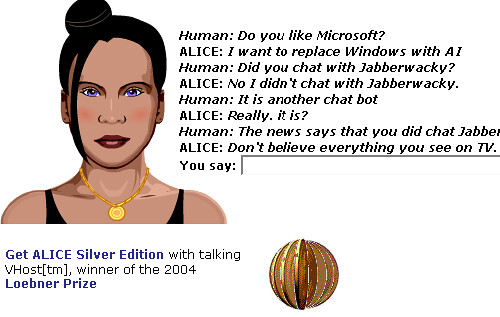
Recently, chatbot techniques have been used for several practical purposes such as online help, personalised services or information acquisition, by working as a conversational agent. One of the classical examples of Chatterbot is A.L.I.C.E, which uses a weak A.I.. In the example of A.L.I.C.E, it uses a programming language called AIML, which is specific to its function as a conversational agent and has been adopted by many developers, which created the called Alicebots.

A.L.I.C.E

The one that I've liked a lot and at some way inspired to develop my own bot was the Aadvark ChatterBot. Aadvark, recently bought by Google, was  a startup focused on creating a social recommendation engine mashing-up some components of Yahoo! Answers and Instant Messaging.  Their service is to offer the user the possibility of asking a question to the bot, and based on its algorithms it will compute its own tag (keywords or you could give it a few) and then, it will find a right person to your question and it will forward it to him in order to  answer. The best part is that Aadvark works very well not only in their web page but also in another clients such as IM's, Iphone, etc.  So you have a question, just open the chat screen of the bot and ask a question and after some minutes you may get a useful answer in the same session (client). Try it for free and see its power!

Aadvark Chat Client


The Tweetcomendas ChatterBot is actually a Jabber Chat Clients which uses the XMPP protocol for receiving and pushing text messages. I've used as an example of another bots that I am planning to develop. Let's see a working example of how it works:

1- First, we have to add the chatter bot tweetcomendas@bot.im (it uses the IMIFIED IM's  bots infrastructure, so you can host your bot there for free.).

2 - After he comes online, you can send at anytime the tracking code of your package order from Correios in order to track it.

It uses regular expressions to match the tracking code.

3 - Wait while he looks at the Correios Tracking WebServices and receive the current status.

The current status in natural language for the user.

3 - Now, another useful feature of the Tweetcomendas ChatterBot is he can actually track for you automatically your order and any new updates he will come to you by giving the new status on your chat client if you're online or by sending you an e-mail (It only works with gmail by now.)

He will ask you politely if you want him to track your order for you.

A gentleman chatterBot :D

4 - Receive new updates of your order by e-mail or by your Jabber Client.

Updates on your e-mail even when you 're not online at the Google Talk


So, this is my first attempt to develop real useful chatter bots for helping users in order to track their post orders. There are many ideas in my mind that I want to create. I believe this kind of tool is the next generation of agents for interacting with people working as an assistant such as the Siri: a mobile assistant agent running on Iphones.  Take a look at the video and see the future of those kind of technologies.


I expect that you have enjoyed my simple bot, it still sometimes can be lazy but in almost of the time it works smoothly. Add to your Google Talk Contacts:  tweetcomendas@bot.im   This is a personal experiment project that I've developed with the help of Ricardo Caspirro (@ricardocaspirro) on intelligent agents and bots.  If you want more information  about it, take a look at its homepage. There is also other client working on Twitter!


That's all,

Cheers,

Marcel Caraciolo

Knowing the 'hidden' class re.Scanner in Python and how to use it: Building a simple Tweet Extractor

Wednesday, September 8, 2010

Hi all,

I've written a simple post at my personal blog (Yes, I have one, but it talks more about my daily life, personal projects and geek stuff) Mobideia about the use of a hidden class 'Scanner' from the module re, responsible for handling with regular expressions.

The practical example includes a simple Tweet Extractor for identify the URLs, (http://www.aimotion.blogspot.com),  usernames (@joao), hashtags (#django), Retweets (RT) and words.  It may be very useful for you who wants to play with Natural Language Processing (NLP) and text mining on Twitter.

In order to avoid the replication of all text here,  I've decided to place the links for accessing the post:

Portuguese Version
http://www.mobideia.com/2010/09/uso-da-classe-escondida-scanner-em.html

English Version (by Google Translate):


http://translate.google.com/translate?js=n&prev=_t&hl=en&ie=UTF-8&layout=2&eotf=1&sl=pt&tl=en&u=http%3A%2F%2Fwww.mobideia.com%2F2010%2F09%2Fuso-da-classe-escondida-scanner-em.html


I hope you enjoy!

Cheers,

Marcel Caraciolo